
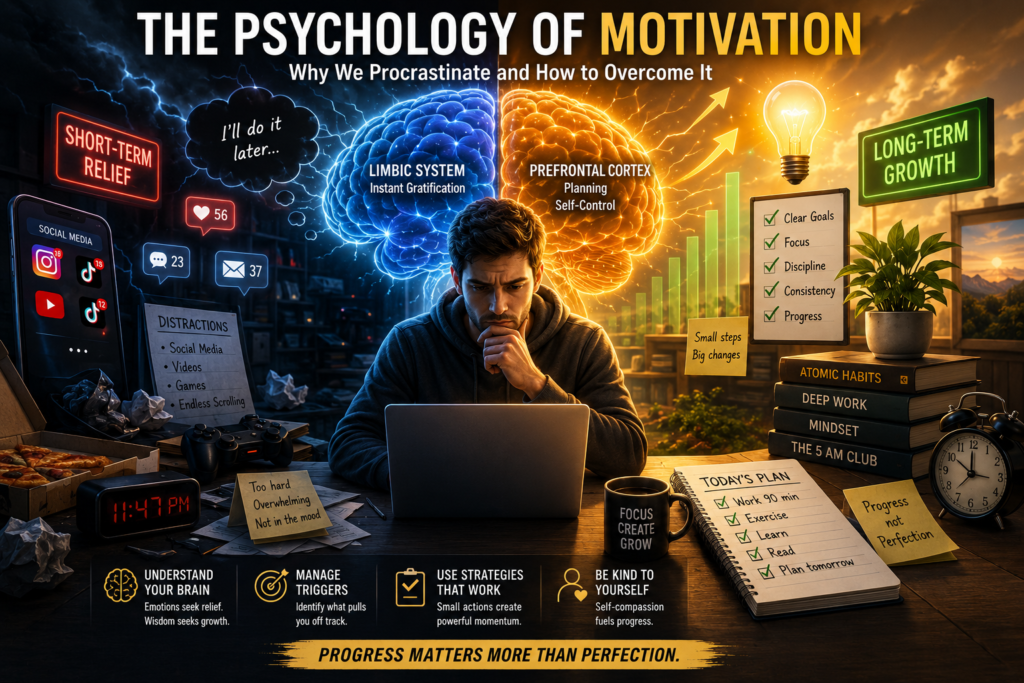
Everyone procrastinates sometimes, even when the task matters and the deadline is close. For about 20% of adults, though, procrastination becomes chronic and starts interfering with work, health, and peace of mind. This article explores the psychological mechanisms that keep you stuck in delay mode, from emotional discomfort to brain-based reward systems. You’ll also learn science-backed strategies that can help you get moving with less stress and more confidence.
Understanding Procrastination: More Than Just Laziness
Procrastination is not simply poor time management, and it is not the same as laziness. Research shows it is better understood as an emotional regulation problem: people delay tasks to avoid uncomfortable feelings like anxiety, boredom, or self-doubt. Two concepts help explain this pattern: temporal discounting, which means we value immediate rewards more than future ones, and present bias, which pulls us toward what feels good right now. In the short term, avoiding the task can feel like relief.
Dr. Tim Pychyl of Carleton University describes procrastination as “giving in to feel good,” and that framing gets to the heart of the problem. Your brain is often choosing short-term mood repair over long-term progress. That is why procrastination can show up even when the goal is important and the consequences are obvious. It is less about failing to care and more about struggling to tolerate discomfort long enough to begin.
The Neuroscience Behind Motivation
Motivation is closely tied to dopamine, the neurotransmitter involved in reward anticipation and learning. When a task seems meaningful or promising, dopamine helps create a sense of drive; when the task feels tedious or uncertain, that signal weakens. At the same time, the prefrontal cortex, which supports planning and self-control, has to compete with the limbic system, which reacts quickly to emotion and reward. That competition helps explain why intentions often collapse the moment a task starts to feel difficult.
The brain can interpret demanding work as a kind of threat, especially when failure feels possible. The amygdala, which helps detect danger, may amplify that reaction and push you toward avoidance instead of action. In other words, procrastination is often a protective response, not a random failure of discipline. Understanding that pattern makes it easier to respond with strategy instead of self-blame.
Common Psychological Triggers of Procrastination
Different triggers can lead to the same delay behavior, but they usually share one thing: they make the task feel emotionally costly.
- Fear of failure: Perfectionism can make starting feel risky because the task becomes tied to your worth. If you do not begin, you never have to face the possibility of falling short, which can temporarily protect self-esteem.
- Task aversiveness: Some tasks are simply boring, repetitive, or mentally draining. Your brain naturally resists things that feel unpleasant, so avoidance becomes the easiest short-term option.
- Low self-efficacy: If you doubt your ability to succeed, starting can feel pointless or overwhelming. That belief often becomes a self-fulfilling cycle, because hesitation reduces practice and reinforces insecurity.
- Impulsiveness: When immediate rewards are especially tempting, it is harder to stay with slow, effortful work. Quick distractions offer instant relief, while the task’s payoff remains abstract and delayed.
- Abstract goals: Vague goals do not give your mind a clear next move. Without specific steps, motivation has nothing concrete to latch onto, so the task stays mentally distant.
- Decision fatigue: Too many options can drain mental energy before you even begin. When your brain is overloaded by choices, procrastination can feel like the easiest way to avoid another decision.
Evidence-Based Strategies to Overcome Procrastination

1. The Two-Minute Rule
Start with just two minutes of the task, even if that feels almost too small to matter. The point is not to finish everything at once; it is to reduce emotional resistance and create momentum. Behavioral psychology research shows that once action begins, the barrier to continuing often drops. A tiny start can be the difference between avoidance and progress.
2. Implementation Intentions
This “if-then” planning technique was popularized by psychologist Peter Gollwitzer, and it works by linking a cue to a specific action. For example: “If it’s 9 AM, then I will write for 30 minutes.” Studies on implementation intentions have shown strong improvements in follow-through, with some reporting up to a 91% increase in goal achievement. The clearer the cue, the less room there is for hesitation.
3. Temptation Bundling
Temptation bundling pairs a boring task with something enjoyable so the task becomes easier to approach. In research by behavioral economist Katherine Milkman, people were more likely to stick with difficult habits when they could combine them with a reward. For example, only listen to your favorite podcast while doing a dreaded chore or admin task. You are not trying to eliminate enjoyment; you are using it to support effort.
4. Self-Compassion Over Self-Criticism
Research by Dr. Kristin Neff shows that self-criticism tends to increase stress, shame, and procrastination rather than reduce them. Self-compassion does the opposite: it lowers anxiety, supports emotional resilience, and makes it easier to re-engage after a setback. When you treat yourself the way you would treat a friend, you create more room for problem-solving and less room for avoidance. Kindness is not indulgence; it is often what allows action to restart.
5. Environmental Design
Your environment can either support motivation or quietly sabotage it. Remove distractions, reduce friction, and make the behavior you want easier to start than the behavior you want to avoid. That is the logic behind James Clear’s atomic habits principles: design the space so good habits are obvious and bad habits are inconvenient. Small changes in your workspace can produce big changes in follow-through.
When to Seek Professional Help
If procrastination is chronic and deeply disruptive, it may be a sign of something larger such as ADHD, depression, or anxiety. In those cases, the problem is not simply habit—it may reflect an underlying mental health condition that deserves attention. If delay is interfering with daily functioning, work performance, relationships, or self-care, consider speaking with a mental health professional. cognitive-behavioral therapy has shown effectiveness for procrastination, especially when it is tied to anxiety and unhelpful thinking patterns.
Moving Forward: Small Steps, Big Changes
Procrastination is a psychological challenge, not a character flaw. Once you understand the mechanisms behind it—emotion, reward, fear, and environment—you can stop treating delay like a moral failure and start treating it like a solvable pattern. Try a few strategies, notice what actually works for you, and be willing to adjust as you go. Progress matters more than perfection, and every small start builds trust in your ability to follow through. The real goal is not flawless productivity; it is reclaiming your time, your energy, and your momentum so you can move toward the goals that matter most.