Separating fiction from reality and understanding the science behind OCD

Introduction
Obsessive-Compulsive Disorder (OCD) is one of the most misunderstood mental health conditions. You’ve probably heard people say “I’m so OCD about my desk” or seen TV characters portrayed as quirky perfectionists. But real OCD is far more complex and challenging than these stereotypes suggest.
Understanding the truth about OCD is crucial—not just for those living with the condition, but for family members, friends, and society as a whole. Let’s separate the myths from the facts and explore what science really tells us about OCD.
Common Myths vs. Reality
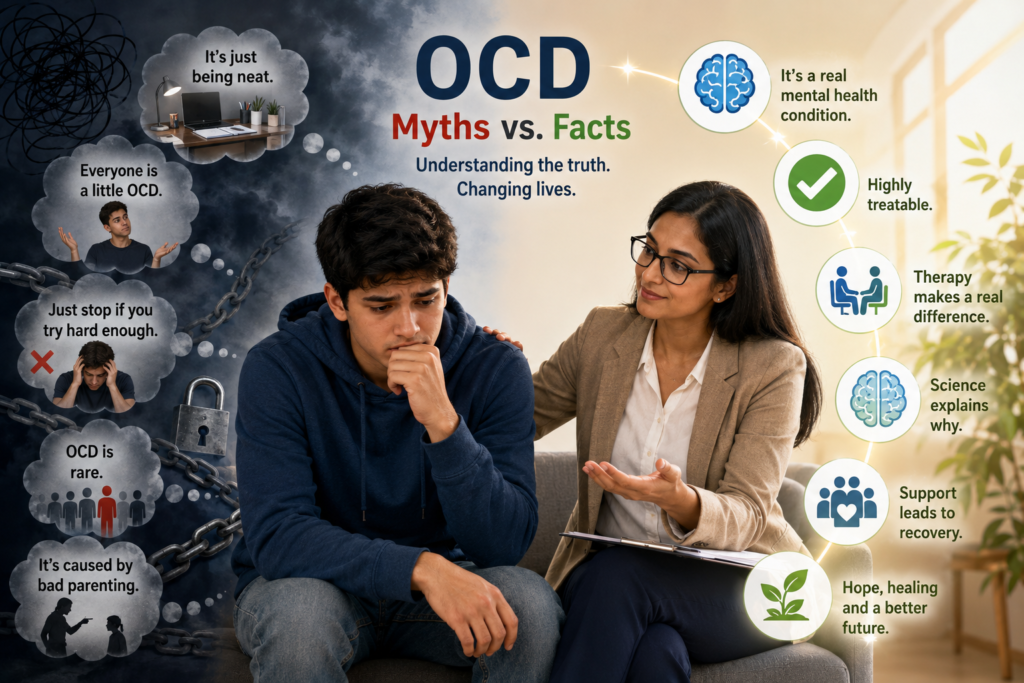
MYTH #1: “OCD is just about being neat and organized”
FACT: OCD is a serious mental health disorder, not a personality trait.
While some people with OCD do have contamination fears or ordering compulsions, OCD encompasses much more. It involves:
- Intrusive, unwanted thoughts that cause severe anxiety
- Time-consuming rituals that interfere with daily life
- Significant distress and impairment
Many people with OCD actually have messy homes because their rituals focus on other areas, like checking, counting, or mental compulsions.
The Science: OCD involves abnormal activity in specific brain circuits connecting the orbitofrontal cortex, anterior cingulate cortex, and basal ganglia. These areas control error detection, decision-making, and habit formation.
MYTH #2: “Everyone is a little OCD”
FACT: Having preferences or liking things organized is NOT the same as having OCD.
It’s normal to:
- Prefer a clean workspace
- Double-check that you locked the door
- Have routines you enjoy
OCD is diagnosed when:
- Obsessions and compulsions take up more than an hour daily
- They cause significant distress
- They interfere with work, relationships, or daily activities
- The person feels unable to control or stop them
The Difference: Preference vs. compulsion. If you like things neat but can function when they’re not, that’s a preference. If you MUST arrange things and feel intense anxiety when you can’t, that may be OCD.
MYTH #3: “OCD is just excessive worrying”
FACT: OCD is distinct from generalized anxiety, though they can co-exist.
Generalized Anxiety Disorder (GAD):
- Worries about real-life concerns (money, health, work)
- Worries feel somewhat realistic
- No specific rituals to reduce anxiety
OCD:
- Intrusive thoughts often feel bizarre or irrational
- Specific compulsions performed to reduce anxiety
- Thoughts are repetitive and unwanted
- Often involves magical thinking (“If I don’t do this, something bad will happen”)
The Science: While both involve anxiety, OCD has a unique pattern of obsessions followed by compulsions, creating a cycle that reinforces itself through negative reinforcement.
MYTH #4: “People with OCD can just stop if they try hard enough”
FACT: OCD is not a choice or a matter of willpower.
Telling someone with OCD to “just stop” is like telling someone with diabetes to “just make more insulin.” OCD involves:
- Neurobiological differences in brain structure and function
- Imbalances in neurotransmitters, particularly serotonin
- Genetic factors that increase vulnerability
The Science: Brain imaging studies show that people with OCD have different patterns of brain activity. The brain’s “alarm system” is overactive, making it difficult to dismiss intrusive thoughts or feel certain that a task is complete.
MYTH #5: “OCD is rare”
FACT: OCD affects approximately 2-3% of the global population.
That means:
- About 1 in 40 people will experience OCD in their lifetime
- In India alone, millions of people live with OCD
- It affects people of all ages, genders, and backgrounds
- It’s as common as diabetes
Many cases go undiagnosed because people feel ashamed or don’t realize their symptoms are treatable.
MYTH #6: “OCD is caused by bad parenting or childhood trauma”
FACT: OCD is a neurobiological condition with multiple contributing factors.
What Actually Causes OCD:
- Genetics: Having a family member with OCD increases risk by 4-5 times
- Brain Chemistry: Imbalances in serotonin and other neurotransmitters
- Brain Structure: Differences in specific brain regions
- Environmental Factors: Stress, illness, or life changes may trigger onset in vulnerable individuals
Important: While trauma can worsen symptoms or trigger onset, it doesn’t cause OCD. Parents are NOT to blame.
MYTH #7: “OCD only involves cleaning and hand-washing”
FACT: OCD has many different types and themes.
Common OCD Types:
- Contamination OCD: Fear of germs, dirt, or illness
- Checking OCD: Repeatedly checking locks, appliances, or actions
- Symmetry/Ordering OCD: Need for things to be “just right”
- Intrusive Thoughts OCD: Unwanted thoughts about harm, sex, or religion
- Hoarding OCD: Difficulty discarding items
- Counting/Repeating OCD: Need to count or repeat actions a specific number of times
- Relationship OCD: Obsessive doubts about relationships
- Health OCD: Excessive worry about having serious illnesses
Many people experience multiple types, and themes can change over time.
MYTH #8: “OCD can’t be treated”
FACT: OCD is highly treatable with the right approach.
Effective Treatments:
1. Cognitive Behavioral Therapy (CBT) – Specifically ERP:
- Exposure and Response Prevention is the gold standard
- 60-80% of people who complete ERP show significant improvement
- Teaches the brain that feared outcomes won’t happen
2. Medication:
- SSRIs (Selective Serotonin Reuptake Inhibitors) help 40-60% of people
- Often used in combination with therapy for best results
3. Combination Treatment:
- Therapy + medication often works better than either alone
The Science: Brain imaging shows that successful treatment actually changes brain activity patterns, normalizing the overactive circuits involved in OCD.
MYTH #9: “If you have OCD, you’ll have it forever”
FACT: While OCD is often chronic, many people achieve significant recovery.
The Reality:
- Many people learn to manage symptoms so well they no longer interfere with life
- Some experience complete remission
- Others have periods of improvement and occasional flare-ups
- Early treatment leads to better long-term outcomes
Key Point: “Managing OCD” doesn’t mean symptoms disappear completely—it means learning skills to prevent OCD from controlling your life.
MYTH #10: “People with OCD are dangerous”
FACT: People with OCD are NOT more violent or dangerous than anyone else.
In fact, the opposite is often true:
- Many people with OCD have intrusive thoughts about harming others, which terrifies them
- These thoughts are ego-dystonic (go against their values)
- They go to great lengths to PREVENT any harm
- Research shows people with OCD are no more likely to act on violent thoughts than the general population
The Science: Intrusive thoughts are a symptom of OCD, not desires or intentions. The distress these thoughts cause is actually evidence of the person’s moral character.
MYTH #11: “OCD is the same as being a perfectionist”
FACT: Perfectionism and OCD are different, though they can overlap.
Perfectionism:
- Desire to achieve high standards
- Pride in accomplishments
- Can be adaptive and helpful
- Person feels satisfied when standards are met
OCD:
- Driven by fear and anxiety, not achievement
- Never feels “good enough” or “complete”
- Causes distress, not satisfaction
- Interferes with productivity rather than enhancing it
Example: A perfectionist might spend extra time on a project to make it excellent. Someone with OCD might rewrite the same paragraph 50 times because it doesn’t “feel right,” never finishing the project.
MYTH #12: “Children can’t have OCD”
FACT: OCD commonly begins in childhood or adolescence.
The Reality:
- Average age of onset is 19-20 years
- About 25% of cases begin by age 14
- Some children show symptoms as early as age 4-5
- Childhood OCD is often misunderstood as behavioral problems
Important: Early identification and treatment in children leads to better outcomes and prevents years of unnecessary suffering.
Understanding the Science Behind OCD

What Happens in the Brain?
1. The OCD Circuit:
Three main brain areas are involved:
- Orbitofrontal Cortex: Detects errors and potential threats (overactive in OCD)
- Anterior Cingulate Cortex: Processes emotions and conflict (overactive in OCD)
- Basal Ganglia: Controls habits and movements (dysfunction in OCD)
2. The “Stuck” Feeling:
In OCD, the brain’s “error detection” system is too sensitive. It keeps sending “something’s wrong” signals even when nothing is wrong, creating the feeling that something is incomplete or dangerous.
3. Neurotransmitter Imbalance:
Serotonin, which helps regulate mood and anxiety, doesn’t function properly in OCD. This is why SSRIs (which increase serotonin) can help.
The OCD Cycle:
- Trigger: Something activates an intrusive thought
- Obsession: Unwanted, distressing thought appears
- Anxiety: Intense fear or discomfort
- Compulsion: Ritual performed to reduce anxiety
- Temporary Relief: Anxiety decreases briefly
- Reinforcement: Brain learns that compulsion “works,” strengthening the cycle
Why It’s Hard to Break: Each time you perform a compulsion, you reinforce the brain’s belief that the obsession was a real threat. This is why treatment focuses on breaking this cycle.
How Treatment Works: The Science of Recovery
Exposure and Response Prevention (ERP):
What It Does:
- Gradually exposes you to feared situations
- Prevents the compulsive response
- Teaches the brain that the feared outcome doesn’t happen
- Anxiety naturally decreases over time (habituation)
The Science: This process is called “extinction learning.” The brain creates new neural pathways that compete with the OCD pathways, eventually weakening the OCD response.
Medication (SSRIs):
How It Works:
- Increases serotonin availability in the brain
- Helps regulate the overactive OCD circuits
- Reduces the intensity of obsessions and urges to perform compulsions
Important: OCD often requires higher doses of SSRIs than depression does, and it may take 10-12 weeks to see full effects.
What You Can Do: Supporting Someone with OCD
DO:
✓ Educate yourself about OCD
✓ Be patient and supportive
✓ Encourage professional treatment
✓ Celebrate small victories
✓ Maintain normal routines
✓ Listen without judgment
DON’T:
✗ Participate in rituals or provide excessive reassurance
✗ Tell them to “just stop” or “calm down”
✗ Get frustrated when they can’t control symptoms
✗ Make OCD jokes or use “OCD” casually
✗ Modify family life to accommodate OCD
✗ Compare their OCD to normal preferences
Frequently Asked Questions
Q: Is OCD a form of anxiety disorder?
A: OCD was previously classified as an anxiety disorder but is now in its own category called “Obsessive-Compulsive and Related Disorders” in the DSM-5. However, anxiety is a major component of OCD.
Q: Can stress cause OCD?
A: Stress doesn’t cause OCD, but it can trigger onset in people who are genetically vulnerable, and it often worsens existing symptoms.
Q: Are intrusive thoughts normal?
A: Yes! About 90% of people experience intrusive thoughts occasionally. The difference in OCD is the frequency, intensity, and distress they cause, plus the compulsions that follow.
Q: Can OCD develop suddenly?
A: While OCD usually develops gradually, some people (especially children) can experience sudden onset, sometimes following an illness or stressful event.
Q: Is OCD related to autism?
A: They are separate conditions, but they can co-occur. Some symptoms may look similar (repetitive behaviors, need for routine), but the underlying causes and experiences are different.
Final Thoughts: Moving Beyond Misconceptions
OCD is not a quirk, a personality trait, or a preference for cleanliness. It’s a real, treatable neurobiological condition that affects millions of people worldwide. Understanding the facts helps:
- Reduce stigma so people feel comfortable seeking help
- Improve support from family, friends, and communities
- Encourage early intervention for better outcomes
- Promote accurate representation in media and conversation
If you or someone you know is struggling with OCD, remember: it’s not your fault, you’re not alone, and help is available. With proper treatment, people with OCD can and do recover.
Let’s replace myths with understanding, and stigma with support.
Meta Title: OCD Myths and Facts: Debunking Misconceptions About OCD
Meta Description: Discover the truth about OCD. Learn the science behind obsessive-compulsive disorder and debunk common myths with facts from mental health experts.